
AI Coding Assistant in 2026: Productivity Boost or Technical Debt Trap?
The AI coding assistant has moved from novelty to default tooling in modern software teams.
In 2025, DORA reported that 90% of software development professionals use AI in some part of their work.
Stack Overflow found that 84% of developers are already using or planning to use AI tools, and about 51% of professional developers use them daily.
The adoption wave is real. But wide adoption has not settled the debate. It has sharpened it.
The real 2026 question is not whether AI code generation works. In fact, it clearly does in many situations.
The real question is much more uncomfortable.
Is it actually making software teams better?
Or is it helping them create technical debt at machine speed?
The frustrating answer is that both sides are right.
The Part Nobody Wants to Admit
The weirdest thing about the AI coding boom is that it can feel incredible even when the net result is messy.
A classic example comes from GitHub’s widely cited Copilot study, where developers completed a coding task 55.8% faster with AI assistance.
Then, a much larger 2025 field study across 4,867 developers found a 26.08% increase in completed tasks.
If you stop there, the story sounds simple: AI code generation works, productivity wins, case closed.
But then METR published a randomized trial that hit like a bucket of cold water.
Experienced open-source developers working on repositories they already knew were actually 19% slower with AI tools.

AI coding productivity evidence ranges from 55.8 percent faster task completion to 19 percent slower performance, depending on the study context
Even more revealing, many of them still believed the tools had helped.
That gap between feeling faster and being faster may be one of the most important truths in all of software development AI right now.
So no, the research is not “confused.” It is showing that AI coding assistant performance depends heavily on the situation.
Where AI coding assistants really shine
When the task is narrow, repetitive, or annoying, AI can feel like having a ridiculously fast intern who never gets tired.
That is where AI code generation tends to earn its keep: boilerplate, docs, test scaffolding, simple CRUD flows, routine migrations, low-risk bug fixes, and the first draft of something you were already going to write anyway.
That is also why the GitHub and multi-company field studies look so strong. In bounded contexts, these tools genuinely reduce friction.
And that matters because adoption is no longer niche.
DORA’s 2025 report says 90% of surveyed software professionals use AI at work, while 65% report moderate to heavy reliance.
Stack Overflow’s 2025 survey found 84% of respondents are using or planning to use AI tools, and about 51% of professional developers use them daily.
This is not experimental anymore. It is mainstream behavior.
But here’s where the story gets messy
Software development is not just typing code.
That is the trap a lot of AI marketing quietly steps around.
According to Atlassian’s 2025 developer experience research, developers spend only about 16% of their time coding.
The rest disappears into code review, debugging, finding information, waiting on systems, switching context, understanding requirements, and coordinating with other humans.
So if your shiny new AI coding assistant for software development only speeds up the code-writing part, it is optimizing one slice of a much bigger machine.
And that is exactly why so many teams are feeling a strange kind of disappointment.
They are clearly producing more code. They are clearly using AI more often. But the business does not always feel dramatically faster.
Because the bottleneck did not disappear. It moved.
The real danger: acceleration without absorption
This is where your article’s core thesis gets powerful.
Faros’ 2025 analysis makes the tension brutally clear.
During higher-AI-adoption periods, epics completed per developer rose 66% and code-related tasks rose 210%.
On paper, that sounds like a dream. But at the same time, PR review time rose 91%, bugs per developer rose 54%, and 31% more code reached production without review.
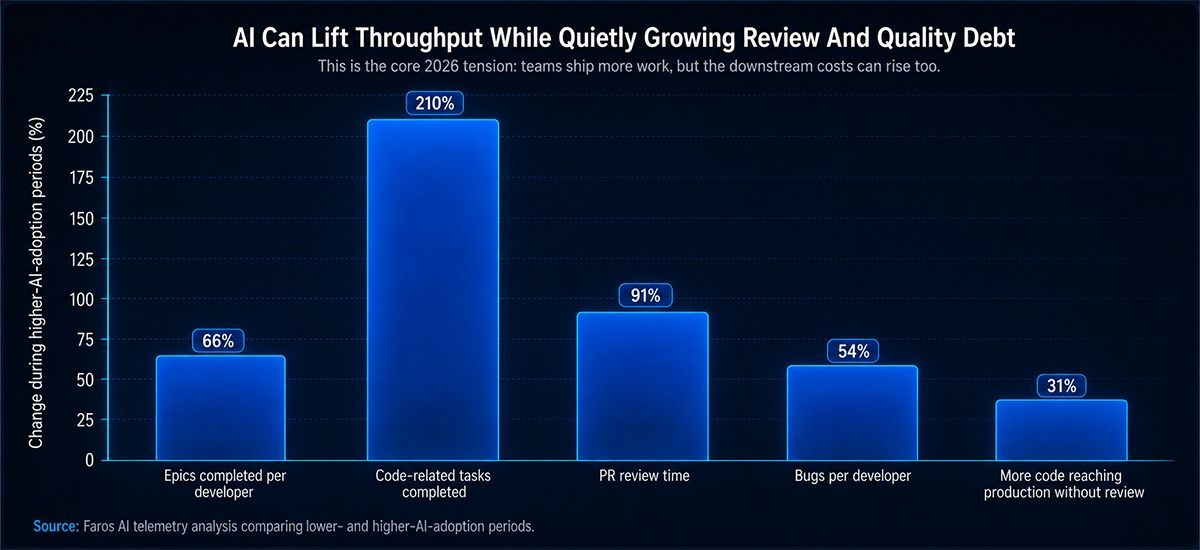
AI increases coding throughput, but can also increase review time, bugs, and unreviewed code in production
That is not just a warning sign. That is a software organization being pulled in two directions at once.
This is why the “AI coding assistant vs technical debt” debate feels so emotionally charged. Because both camps are seeing something true.
One camp sees developers moving faster and shipping more.
The other sees review queues swelling, quality slipping, and long-term maintainability getting weirdly fragile.
They are not disagreeing about reality. They are looking at different layers of the same system.
Why trust is still lagging behind adoption
If AI were truly solving the whole problem, developers would trust it more than they do.
But they do not.
DORA’s 2025 findings show that only 24% of respondents report high trust in AI output, while 30% report low or no trust.
Stack Overflow’s 2025 survey also shows strong adoption alongside rising hesitation, with only about 61% expressing favorable sentiment, and a separate Stack Overflow leadership analysis noting trust in output accuracy has fallen sharply.
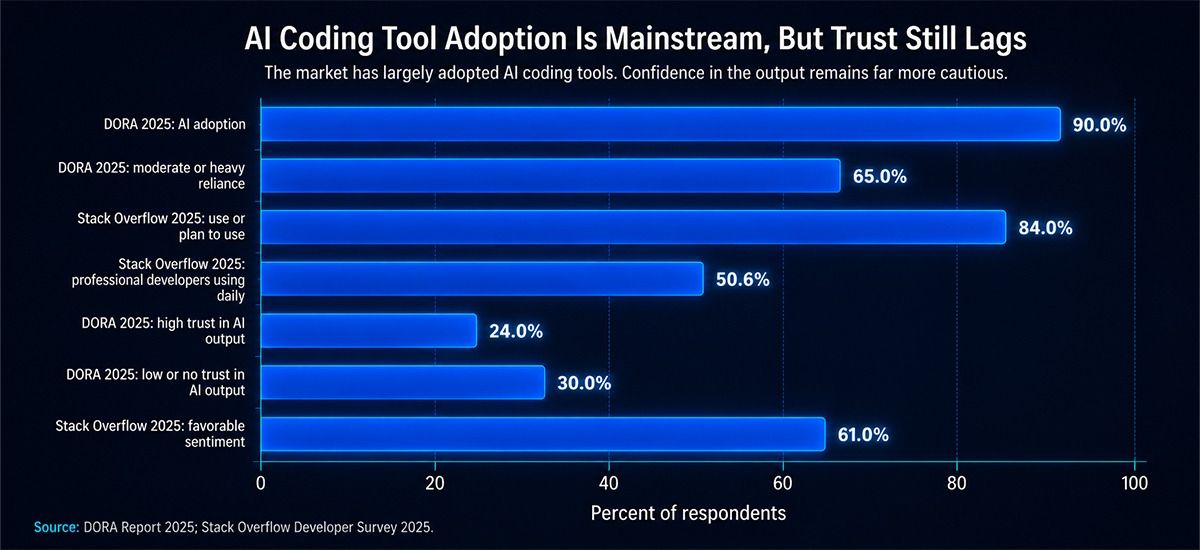
AI adoption among developers is high, but trust in AI-generated output remains much lower
In plain English: Developers are using these tools all the time, but a lot of them still treat the output like something that needs babysitting.
That makes total sense. AI-generated code often looks polished before it is truly correct. It can sound confident while quietly violating architecture patterns, security expectations, or edge-case handling.
So the emotional experience is seductive, but the engineering reality still demands supervision.
The hidden cost isn’t bad code. It’s seductive code.
That distinction matters.
The biggest danger with an AI coding assistant is not always that it writes obviously terrible code.
Sometimes the bigger risk is that it writes code that looks clean enough to merge but adds duplication, weak abstractions, inconsistent patterns, or unexamined security flaws.
That is why the strongest 2026 argument against careless AI adoption is not “AI writes garbage.”
It is “AI makes it too easy to create code faster than your system can validate, absorb, and maintain it.”
That is a much more serious problem because it scales quietly.
So, are AI coding assistants worth it?
Yes, but not as a standalone answer.
If your team is looking for a simple yes-or-no verdict, here it is:
AI coding assistants for software development are worth it when you optimize the surrounding engineering system. They are dangerous when you optimize only code output.
The best use cases in 2026 are –
repetitive implementation work
test scaffolding
documentation
onboarding and repo discovery
migration assistance
bug-fix drafting
internal tool creation
low-risk backlog items
The riskiest use cases are –
compliance-sensitive systems
security-critical code
architecture-heavy work
broad multi-service refactors
changes that bypass strong review and testing controls
The Future is Probably More Agentic and More Demanding
This conversation gets even more intense as the market moves from assistants to agents.
Today’s software development AI agents are starting to do more than suggest code.
They can inspect repositories, plan changes, edit multiple files, run commands, execute tests, and open pull requests.
That is exciting because it pushes AI beyond autocomplete and into actual workflow acceleration.
But it also raises the stakes. If a basic assistant can generate questionable code faster, an agent can generate questionable workflow momentum faster, too.
So the future is not just “more AI.” There is more responsibility around AI.
How to use an AI coding assistant without creating technical debt
The smartest teams are no longer asking, “Which tool should we buy?”
They are asking, “What controls and metrics let us capture speed without losing quality?”
A strong operating model in 2026 looks like this:
1. Measure end-to-end delivery, not just coding speed.
Track lead time, deployment frequency, PR size, review time, defect escape rate, security findings, change failure rate, and incident rate. If your team only measures commits or output volume, you may confuse acceleration with improvement.
2. Harden the merge boundary.
Require review of AI-heavy code, raise expectations for automated testing, run dependency and security scans earlier, and make it easy for reviewers to see what changed and why. Veracode’s results make security validation essential, not optional.
3. Use AI more aggressively for bounded work than for architectural work.
The research shows the biggest gains in narrow tasks, while complex familiar-repo work can see smaller gains or slowdowns.
4. Tailor rollout by developer seniority.
Less experienced developers often gain more from AI support, but they also need stronger review and mentorship. Senior engineers should spend more of their energy on architecture, review quality, guardrails, and workflow design.
5. Optimize the whole lifecycle.
Because coding is only a fraction of development work, the biggest ROI may come from using agents to reduce information hunting, context switching, and repetitive process work, not just writing more code faster.
Final Verdict
The future of the AI coding assistant is not autocomplete. It is orchestration.
In 2026, the winning teams will not be the ones that generate the most code.
They will be the ones who combine AI code generation, robust review systems, automated testing, security validation, architectural discipline, and agentic workflow design into a coherent software delivery model. The losers will be the teams that mistake faster code output for real software productivity.
So, is an AI coding assistant for software development a productivity boost or a technical debt trap?
It is a productivity boost only when the organization is mature enough to stop it from becoming a technical debt trap.
FAQ
Do AI coding assistants actually improve productivity?
Yes, often but not always. GitHub’s well-known Copilot study found developers completed a coding task 55.8% faster, while METR found experienced open-source developers working on familiar repositories were 19% slower with AI tools. The impact depends heavily on task type, codebase familiarity, and how much review and correction the output needs.
Why can AI coding assistants increase technical debt?
They can increase technical debt because they make code generation faster than many teams can review, test, secure, and maintain it. When code output rises without stronger process controls, review overhead, defects, and long-term maintenance costs can rise too.
Are AI coding assistants replacing software developers?
No. They are changing the shape of the work. Since developers spend only about 16% of their time coding, the bigger opportunity is not just writing code faster but reducing friction around context gathering, review, testing, and coordination.
What is the difference between an AI coding assistant and an AI coding agent?
An AI coding assistant mainly helps with code suggestions, explanations, and edits. An AI coding agent goes further by planning tasks, navigating repositories, running commands, updating files, and helping complete broader workflows with more autonomy. This shift is one reason the AI coding market is moving beyond basic code completion.
Are Copilot alternatives worth considering in 2026?
Yes. The category has expanded beyond one tool, and many teams now compare assistants and agents based on repo context, workflow fit, governance needs, and how much autonomy they want. The right choice usually depends more on team environment than on hype.
What should teams measure after adopting an AI coding assistant?
Teams should measure PR review time, defect rates, change failure rate, rework, security findings, and deployment outcomes. Not just code output or the number of suggestions accepted. That is the difference between measuring speed and measuring real engineering performance.