
How is Artificial Intelligence revolutionizing digital marketing by 2026?
As companies adopt fully automatic systems, AI in digital marketing is expanding at a record level in 2026. Businesses concentrating on AI in digital marketing are seeing a clear rise in consumer interaction and return on investment as opposed to more traditional techniques. Companies can properly predict consumer behavior before any action is taken by including AI in digital marketing. Knowing the specifics of how AI in digital marketing is transforming businesses in 2026 has become vital for people wanting to succeed online.
Central to the role of AI in digital marketing in today's worldwide market is the making of judgments based on data. Many industry leaders believe AI in digital marketing helps to rapidly react to real-time shifts in the economy. Going further, we see that AI in digital marketing creates very customized content tailored to particular audience groups. AI's technical configuration in digital marketing enables simple integration over many social and search channels.
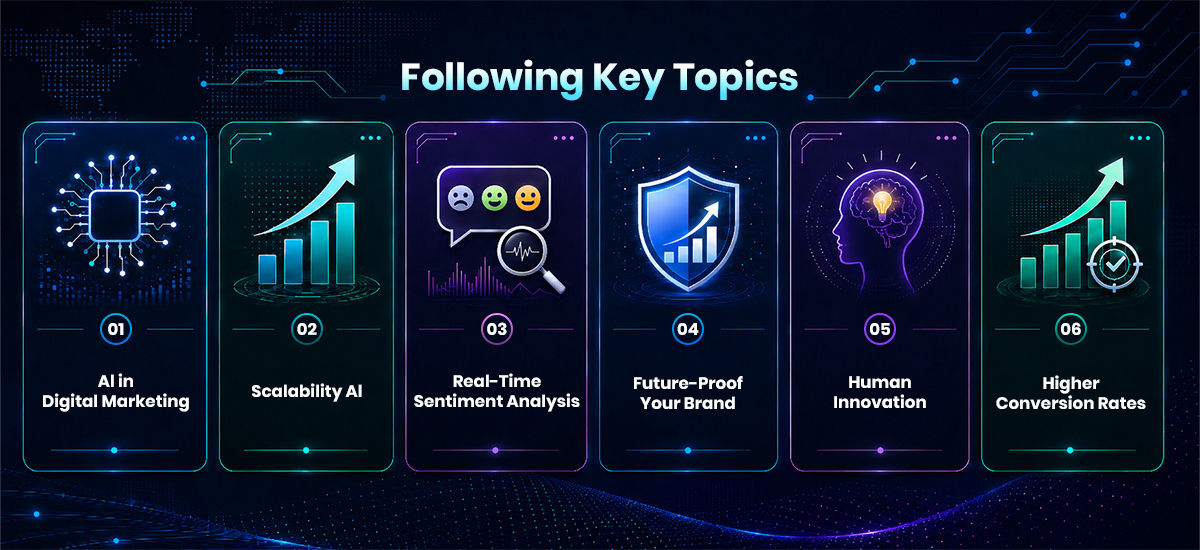
Using AI in digital marketing requires a strategic shift from manual control to algorithm-based administration. Many businesses have come to understand that AI in digital marketing improves the creative capability of marketing teams while reducing human errors. Scalability AI enables smaller companies to level with major ones. AI in digital marketing also enables marketers to automate mundane activities like lead assessment and sorting emails.
Mastering AI in digital marketing solutions that provide real-time sentiment analysis will help to future-proof your brand. The present scene of AI in digital marketing highlights the need for ethics and data transparency in order to keep consumer trust. You are probably lagging behind rivals who use machine learning for optimization if your company is not yet using AI in digital marketing. Ultimately, the interaction of human innovation and machine effectiveness determines how well AI in digital marketing works.
Successful expansion in 2026 depends mostly on a strong ad campaign using automated bidding methods. On major e-commerce sites, the convergence of digital marketing and AI has radically altered product discovery. Experts frequently highlight the convergence of digital marketing and AI as the main force behind higher conversion rates across retail industries. Improving your ad approach enables improved targeted positioning during busy shopping events as well as more effective inventory control. The capacity to immediately evaluate rival pricing gives a clear advantage in the world of digital marketing and AI. Therefore, when maximizing sponsored product advertising for highest exposure, the link between digital marketing and AI is most clearly visible.
Brands hoping to engage high-intent customers must use a data-driven advertising strategy. The relationship of digital marketing with AI guarantees that ad expenditures are automatically assigned to the most lucrative keywords. We notice that digital marketing and AI instruments can now produce product descriptions matching voice search patterns. Incorporating a complex advertising plan helps to dramatically lower acquisition cost over long-term campaigns. Professionals specializing in AI and digital marketing concentrate on developing comprehensive customer journeys that connect social media with store checkouts. The ongoing feedback mechanism in AI and digital marketing means that campaigns grow smarter and more effective daily.
Creating a multi-layered advertising plan calls for predicting seasonal demand peaks using predictive modeling. Marketers can generate dynamic creative assets that change depending on personal user preferences by combining AI and digital marketing. From simple chatbot consumer service to advanced programmatic purchasing, the larger field of artificial intelligence and digital marketing comprises everything. A good advertising plan has to take into account the growing complexity of the algorithm and its dependence on machine learning. The line between organic search and paid positioning grows more hazy as artificial intelligence and digital marketing develop.

AI in digital marketing
The Growth of Hyper-Personalization:
Digital marketing's golden standard is hyper-personalization, which will be made possible by artificial intelligence by 2026. In the past, all it took to wow a subscriber was a simple first name tag in an email; those days are long gone. Nowadays, systems that analyze past purchasing behavior, surfing history, and even current environmental factors like the local weather create customized marketing messages. The level of detail in this degree ensures that the customer is reached at the exact moment and with the appropriate level of significance. Instead of shouting into a void, brands are now engaging in millions of individual conversations at once. This transition has been made easier by big language models that can generate unique text for each user in real time.
Generative AI and the Velocity of Content:
Content velocity has become a key success indicator in today's digital world. With the help of digital marketing with AI, brands can now produce a quantity of high-quality content, videos, and social media updates that were previously unheard of. Modern generative techniques have advanced to the point where they can maintain brand voice and atmosphere without sacrificing quality in favor of quantity. Designers can now change concepts more quickly thanks to creative suites driven by artificial intelligence, which once took days to complete. Due to this pace, businesses may immediately benefit from trending issues and, as a result, remain competitive in a dynamic social environment. Content is a living thing that evolves based on interaction data, not a static asset.
The Future of Search Engine Optimization:
The evolution of search engines toward generative search experiences has been revolutionary. The old method of keyword stuffing is no longer used; rather, topical authority and user intent are at the forefront. Optimizing for these upcoming engines requires a thorough understanding of how algorithms interpret natural language and context. At the moment, the primary interaction between the user and the information they require is through artificial intelligence algorithms. As a result, marketers should focus on offering comprehensive, expert-level content that answers complex questions.
Predictive Analytics and Customer Insights:
With predictive analysis, marketers can foresee the future of consumer demand. Artificial intelligence has the ability to identify patterns that the human eye cannot see by analyzing large volumes of historical data. Businesses may use this ability to better manage their inventory and introduce campaigns at the exact moment when consumer demand is expected to be at its highest. Predictive modeling can also be used to identify potential churn before it happens, allowing for preventative client retention strategies. By lowering the chance of failure, data-driven predictions promote the prudent use of marketing dollars.
Communities supported by Artificial Intelligence and Social Media:
Social media platforms will have recommendation engines in 2026 that give actual interaction priority above merely reaching a wide audience. Algorithms right now value material that promotes sincere interaction and community building. AI solutions help community managers rapidly address issues and track the sentiment of thousands of discussions. Automation has made it possible for large companies to interact with brands in a manner they formerly could not. One of the changes in influencer marketing is made possible by artificial intelligence since it lets companies pick the best partners depending on audience overlap and authenticity ratings. The outcome of this is a more transparent and fruitful social scene.
Ethical and Data Privacy Concerns:
Consumer knowledge of the ethical application of artificial intelligence will be the top concern in 2026. The responsibility to use marketing tools ethically grows exponentially as they become more effective. Due to tougher data privacy legislation, companies must now be more honest about their data collection and use. Customers are more likely to trust companies that give privacy a top priority and use artificial intelligence to improve their experience instead of abusing it. Establishing trust demands a dedication to responsibility, equity, and transparency in an AI-driven society. Ignoring these issues exposes businesses to major damage to their reputation as well as legal consequences.
Integrating Visual and Voice Search:
Through visual and voice searches, users now engage with the digital world. Users will sometimes search by voice or by pointing their camera at something, given the widespread wearable devices and smart devices. To be visible, marketing plans have to incorporate these non-textual elements. Understanding these questions and delivering accurate answers depends on artificial intelligence. Giving voice top priority means stressing the long, informal sentences most like genuine human speech. For best visual search, one needs excellent images and thorough metadata that artificial intelligence may readily arrange.
Automated Programmable Advertising:
AI, which spans everything from bid modifications to creative decisions, manages programmatic advertising—currently totally automated. This arrangement guarantees that the correct person sees advertisements on the best medium at the appropriate moment. Real-time bidding occurs in milliseconds under the control of algorithms aiming for the highest conceivable conversion rate. This guarantees that marketing funds are used as efficiently as feasible and helps to lower waste.
The Importance of Cooperation between Humans and Artificial Intelligence:
The irreplaceable center of any successful marketing strategy is still human creativity. AI can process data and create content, but it doesn't have the cultural sensitivity or emotional intelligence that people have. Brands that strike the ideal balance between human intuition and machine efficiency in 2026 will be the most successful. Marketers need to learn how to collaborate with AI and use it as a tool to expand their creative ideas. This partnership makes it possible to develop campaigns that appeal to the heart and are supported by facts. The augmented marketer, who can handle the technical and creative aspects of the industry, will rule the future.
AI and Customer Journey Mapping:
Mapping the consumer journey is now a dynamic process that evolves in real time. AI monitors a user's every interaction with a brand, giving a full picture of their route to making a purchase. With this, marketers can pinpoint friction points and improve the overall experience to increase conversions. Dynamic journey mapping allows for real-time modification of the user's route in order to cater to their individual requirements. The system can instantly provide a discount or further information to encourage a user to take action if they display any indications of reluctance. This degree of responsiveness guarantees that no leads are lost as a result of a subpar user experience.
Video Marketing and AI Synthesis:
Despite the fact that video content still dominates the digital world, AI synthesis has completely changed how it is made. It is now possible to produce customized video messages for thousands of clients. AI can alter the video's language, backdrop, and even the featured products to match the audience. This makes it possible to customize at a degree that was formerly limited to high-end sales calls. Furthermore, interactive video simplifies the route to conversion by enabling consumers to make purchases right inside the player. More brands are now able to tell their stories visually due to the reduced barriers to entry for producing high-quality videos.
AI Optimization and Local Marketing:
With the aid of AI-driven location intelligence, local marketing has grown more sophisticated. Based on a user's actual physical location in real-time and previous actions, brands may now provide hyper-local advertisements. Brick and mortar businesses that want to increase foot traffic will find this to be especially helpful. Local listings can be managed with the help of AI, which also makes sure that company data is consistent across all platforms. By conducting sentiment analysis of local reviews, companies may respond to local issues and enhance their standing in the community. As a result, local shopping becomes more engaging and pertinent.
Future for Email Marketing:
Still a strong tool, email marketing has been transformed by AI-driven orchestration. Rather than sending batch emails, systems now dispatch single emails based on certain user triggers. Artificial intelligence helps to boost open and click-through rates by identifying for each recipient the best subject line, delivery time, and message. Predictive lead scoring focuses sales teams on the most possible prospects. Email is now a very customized way of creating long-term relationships, not just a way to advertise sales. Rather than just sending emails, controlling relationships at scale is currently the first need.
Chatbots and Conversational Commerce:
Most regular interactions will be indistinguishable by 2026 from those between human agents and chatbots. They can answer difficult product inquiries, offer instant help, and even execute whole transactions from inside a chat session. Users like how simple buying is via a simple chat; hence, conversational commerce has become a major revenue source. These bots can understand intention and emotion thanks to the advanced Natural Language Processing they employ. Less strain on human support personnel and greater client pleasure follow from this. The fusion of artificial intelligence into customer service has turned every interaction into a potential marketing chance.
In summary:
Embracing the advancements brought about by artificial intelligence is the only path to flourish in the digital marketing landscape of 2026. The tools and approaches discussed in this article represent important changes in how business is conducted. By using artificial intelligence, marketers can release previously unheard-of degrees of efficiency, creativity, and customer engagement. Ongoing education and adaptation are needed along the way to a fully AI-integrated marketing strategy. Those who know how to combine data with creativity will be the trailblazers of this interesting new age. The change is already here, and the possibilities for people ready to innovate are limitless. Wanna learn more on how we are using AI to transform Digital Marketing in 2026- contact us