
Amazon SEO Explained: A Beginner's Guide to Ranking Higher
What Is Amazon SEO, Really?
If you're new to selling on Amazon, you've probably heard "Amazon SEO" thrown around like it's some mysterious formula only power sellers understand.
It isn't.
Amazon SEO is simply the practice of optimizing your product listings. Hence, Amazon's search engine surfaces them for the right shopper queries, and so those shoppers actually buy once they click.
Unlike Google, Amazon isn't trying to answer a question. It's trying to close a sale.
Every ranking decision Amazon's algorithm makes is really a prediction: how likely is this specific product to convert for this specific search?
That single distinction changes almost everything about how you should approach optimization as a beginner.
From A9 to A10: Why Old Amazon SEO Advice No Longer Works
For years, sellers were taught that keyword stuffing and sales velocity alone would push a listing to page one. That was the A9 algorithm, and it rewarded products primarily for sales velocity and keyword matching, often heavily favoring sponsored placements.
Amazon has since moved to the A10 algorithm, and the rules have genuinely changed. A10 prioritizes real-time customer behavior, conversion velocity, and post-purchase satisfaction over static keyword matching.
In practical terms, this means Amazon now cares less about how many times you cram "Amazon SEO" or your target keyword into a bullet point, and far more about whether people who see your listing actually click it, and whether people who click it actually buy.
One of the more interesting shifts for beginners to understand: A10 has moved ranking weight toward organic engagement and external traffic, rather than paid advertising alone.
That's a meaningful departure from the old playbook, where throwing PPC budget at a new ASIN was often enough to fake early momentum.
The Core Ranking Factors You Actually Need to Know
Strip away the jargon, and A10 comes down to a handful of signals that matter most for a beginner to focus on:
Conversion Rate (CVR)
This is arguably the heaviest-weighted factor in the algorithm today. If 100 people view a page and 15 buy, the conversion rate is 15%, and this percentage acts as a quality score for the listing. A high CVR doesn't just drive sales — it tells Amazon your listing deserves more visibility.
Click-Through Rate (CTR)
This measures whether shoppers find your listing appealing enough to click from the search results page in the first place. A high CTR means shoppers find the listing relevant and appealing from the search results page, while a high CR confirms that people who click are confident enough to complete purchases.
Text and Semantic Relevance
Keyword placement still matters, just not the way it used to. The top three ranking factors remain sales velocity, text relevance in the title, and conversion rate, with availability and Prime eligibility acting as critical gatekeepers for visibility. Crucially, keyword placement within Amazon's algorithm is structured and hierarchical, giving more weight to specific fields like the product title, brand name, product category, and backend search terms, and A10 doesn't factor in keyword density.
Reviews and Return Rate
Customer reviews and return rates are direct ranking inputs, which means product quality and honest listing content aren't just "nice to have" — they're SEO factors in their own right.
External Traffic
This is the factor most beginners overlook entirely. Quality buyers from blog posts, email lists, and creator partnerships push conversion rate up, and A10 reads that as proof that demand exists.
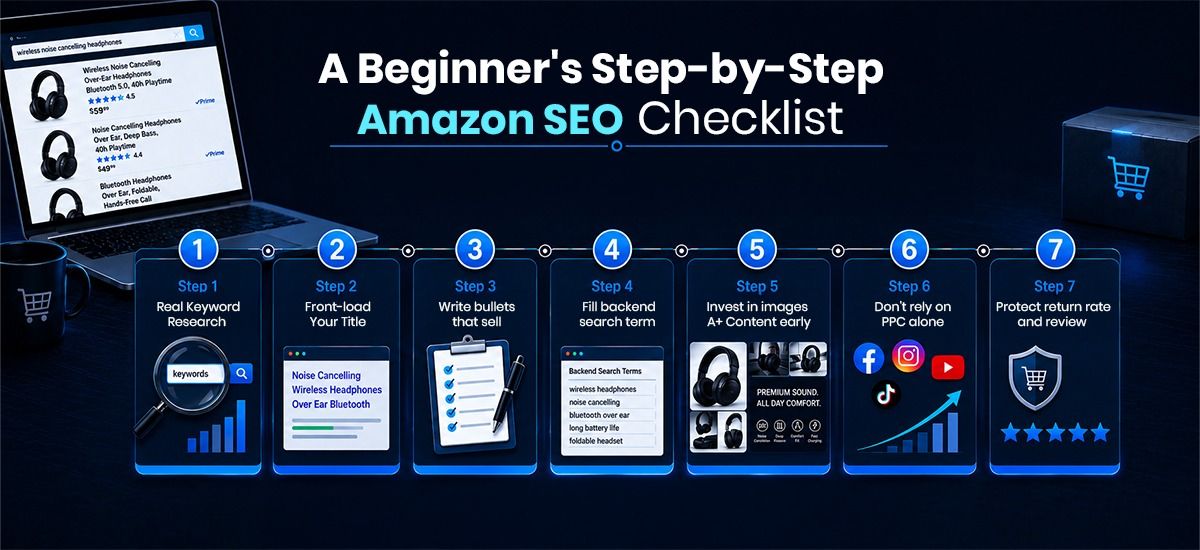
A Beginner's Step-by-Step Amazon SEO Checklist
Step 1: Do real keyword research before you write anything. Use tools like reverse ASIN lookups to see what keywords your top competitors already rank for, rather than guessing.
Step 2: Front-load your title with relevance, not stuffing. Lead with your primary keyword, brand, and the most important product attributes — clearly and readably, not as a keyword dump.
Step 3: Write bullets and descriptions that sell, not just describe. Since CVR is now central to ranking, every bullet should answer a buying objection, not just list a feature.
Step 4: Fill every backend search term field. These hidden fields still carry real SEO weight and are free real estate most beginners leave half-empty.
Step 5: Invest in images and A+ Content early. Enhanced content and strong imagery directly improve CTR and CVR — the two metrics A10 rewards most.
Step 6: Don't rely on PPC alone. Use Google SEO, Google Ads, and social platforms like TikTok, Instagram, and YouTube to drive qualified external traffic, since external traffic is now a major ranking factor under A10.
Step 7: Protect your return rate and review quality. Accurate listings that set correct expectations reduce returns, and returns quietly erode your ranking over time.
The Biggest Mistake New Sellers Make
Most beginners still optimize for a search algorithm that no longer exists. Sellers who keep treating Amazon search like a 2018 keyword game watch their best products downward slide from position 4 to page 3 in a single quarter. The fix isn't more keywords, it's a listing built to convert, backed by real product quality and traffic that actually buys.
To truly understand how Amazon SEO works in practice, it’s important to go beyond theory and apply proven optimization steps. A well-structured product page—including titles, bullet points, images, and backend keywords—directly impacts both rankings and conversions. If you want a step-by-step framework, check out this detailed Amazon Listing Optimization Checklist 2026, where every essential element is broken down for beginners and advanced sellers alike.
Frequently Asked Questions
What is Amazon SEO?
Amazon SEO is the process of optimizing product listings — titles, images, bullets, backend keywords, and reviews — so Amazon's algorithm ranks them higher in search results and shoppers convert once they click.
What is the Amazon A10 algorithm?
A10 is Amazon's current ranking system, which weighs conversion rate, click-through rate, reviews, return rate, and external traffic more heavily than the older A9 algorithm did.
Is keyword stuffing still effective for Amazon SEO?
No. A10 doesn't factor in keyword density, and stuffing keywords can actually hurt readability and conversion rate, which now matters more for ranking.
How is A10 different from A9?
A9 leaned heavily on sales velocity and keyword matching. A10 shifts weight toward conversion rate, post-purchase satisfaction, seller authority, and external traffic.
Does PPC advertising still help Amazon SEO?
Yes, but less directly than before. PPC can build early momentum for new listings, but organic sales and engagement now carry more long-term ranking weight.
What are backend search terms, and why do they matter?
Backend search terms are hidden keyword fields in Seller Central that help Amazon match your listing to relevant searches without cluttering your visible copy.
How important are product reviews for Amazon SEO?
Very much. Reviews signal trust and quality, and they directly influence both conversion rate and Amazon's ranking calculations.
Can external traffic really improve my Amazon ranking?
Yes. Traffic from sources like blogs, email lists, and social media that converts into sales signals genuine demand, which A10 rewards with better organic visibility.
How long does it take to rank on Amazon with SEO?
There's no fixed timeline, but consistent sales velocity, strong conversion rates, and positive reviews typically build ranking momentum over several weeks to a few months.