
Best Amazon Product Research Tools Every Beginner Needs In 2026
You spot a "winning" product on TikTok at 1 a.m., order 500 units, and list it on Amazon. Three months later, it's still sitting in a fulfillment center, racking up storage fees, with zero sales to show for it.
This happens to thousands of new sellers every month. Poor product selection is the single biggest reason new Amazon FBA sellers struggle in year one.
The good news? You don't need luck. You need the right Amazon product research tools, used the right way, from day one.
Why Most Beginner Amazon Sellers Waste Money Before Listing a Single Product
New sellers usually start with a gut feeling. They scroll Amazon, spot something popular, and assume it'll sell for them too.
That gut feeling skips every question that actually matters. Is the demand real or just a seasonal spike? Can you even hit a healthy margin once fees are subtracted?
Amazon's combined fees now eat up roughly 30–35% of a typical seller's revenue between referral fees, fulfillment costs, and storage charges. Guess wrong, and you're underwater before your first unit ships.
What Are Amazon Product Research Tools, and Why Do They Matter So Much?
An Amazon product research tool pulls real marketplace data, sales estimates, Best Seller Rank history, review counts, pricing trends, and keyword search volume, and turns it into something you can act on.
It's the difference between guessing tomorrow's weather and checking an actual forecast. Both involve looking at the sky, but only one gives you real odds.
The strongest Amazon FBA product research tools combine a product finder, a sales estimator, a keyword research tool, and competitor tracking all-in-one dashboard. That combination separates a confident launch from a coin flip.
The Real Numbers Behind Amazon's "Easy Money" Myth
Here's what the data says about selling on Amazon in 2026, no hype attached.
Roughly 64% of Fulfillment By Amazon (FBA) sellers report becoming profitable within their first twelve months, and 46% land profit margins between 11% and 25%.
Encouraging, but it also means a meaningful share never gets there in year one.
There are now over 2.5 million active sellers competing across Amazon's global marketplace. That's not a market you can afford to wing.
Sellers who land in that profitable group share one habit: they validate demand and competition with real data before paying a supplier.
What Makes a Good Amazon Product Research Tool? 7 Must-Have Features
Not every tool listed online deserves your money. Before subscribing, check that it covers these basics.
A large, frequently updated product database tracking BSR, pricing, and reviews over time.
Sales estimators that hold up against real-world checks, not numbers dressed up to impress.
A built-in Amazon keyword research tool with genuine search volume data.
Competitor and listing analysis, so you can spot the weak spots worth beating.
A profit margin calculator built on current FBA fees, not last year's rates.
A Chrome extension for quick research while you browse Amazon search results.
A real free trial or free plan, so you can test before you pay.
If a tool is missing more than two of these, keep shopping.
Best Amazon Product Research Tools for Beginners in 2026, Ranked
Here's the part that actually matters: which Amazon seller tools deserve your first dollar?
1. Jungle Scout — Easiest Tool for Total Beginners
Jungle Scout built its name on being the friendliest entry point into product research.
Its Opportunity Finder scores niches by demand, competition, and price in one number, and its Supplier Database links you to vetted manufacturers.
Plans start around $49/month with a free trial. It's the safest first pick if you've never used a research dashboard.
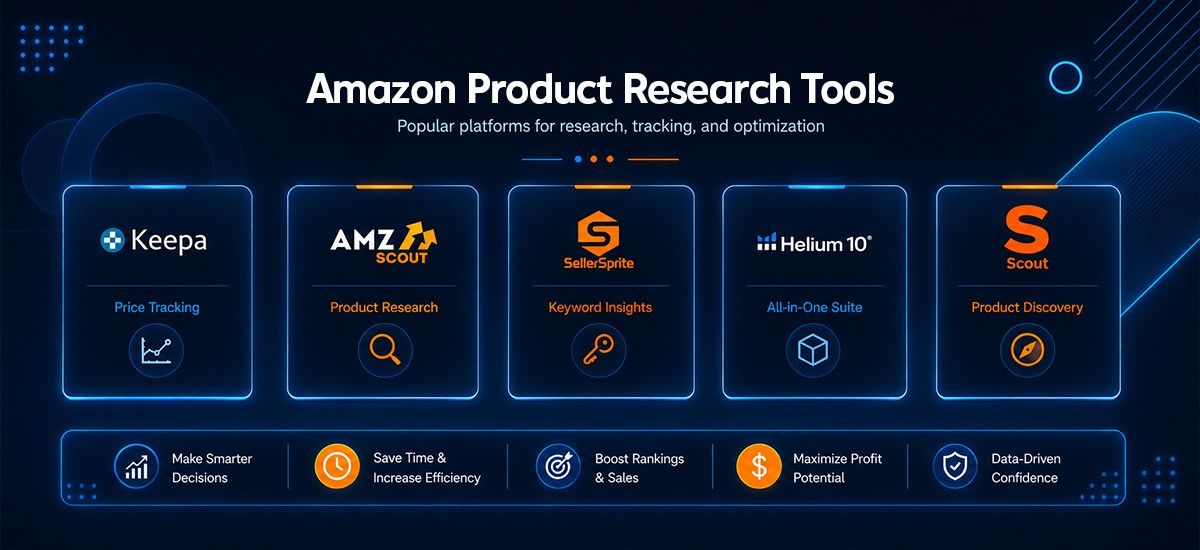
2. Helium 10 — Most Powerful All-in-One Suite
Helium 10 packs over 30 tools into one platform, including Black Box for product discovery, Xray for instant sales data, and Cerebro for reverse-engineering competitor keywords. It goes deeper than Jungle Scout, but the learning curve climbs with it.
Pricing runs from roughly $39 to $279/month, depending on the tier you need.
3. SellerSprite — Best Value for Tight Budgets
SellerSprite delivers comparable product, keyword, and competitor data at a lower price, plus a genuinely usable free plan. Its preset filters make niche-hunting fast, even on day one.
It's the smart pick if you want serious data without a serious bill.
4. AMZScout — Best for Learning the Ropes
AMZScout pairs an affordable Chrome extension and product database with genuinely useful beginner training. It won't out-power Helium 10, but it removes the "where do I even start" confusion that scares off first-timers.
5. Keepa — Essential Add-On, Not a Standalone
Keepa isn't a full research suite; it's a price-history and rank-tracking specialist that costs around $19/month. It answers one question fast: Is this product's demand stable, or just a spike?
Pair it with any tool above as a sanity check before you commit to inventory.
6. Amazon's Product Opportunity Explorer — Free and Native
If you already have Seller Central access, Amazon's own Product Opportunity Explorer surfaces real demand signals straight from the source, at no extra cost. It isn't a full workflow alone, but it's a smart free layer to stack on top of any paid tool.
Free vs Paid Amazon Product Research Tools: Where Should You Start?
You don't need to spend a cent to take your first step. Amazon's own Best Sellers pages, search autocomplete, and the free Product Opportunity Explorer all hand you real signals worth checking first.
Once you've narrowed a few ideas down, that's when a paid Amazon product finder earns its keep, validating before you spend real money on inventory.
Your A-to-Z Amazon FBA Product Research Checklist
Run every product idea through this before you message a single supplier.
Ask if demand is steady or just a seasonal spike; check at least 12 months of history.
Benchmark Best Seller Rank against five or more direct competitors.
Calculate true margin after referral fees, FBA fulfillment fees, and shipping.
Dig through reviews for recurring complaints you could fix.
Estimate keyword search volume instead of assuming people are searching for it.
Factor in seasonality and Q4 storage fee spikes before you order stock.
Go for at least 30% net margin as your non-negotiable minimum.
Skip even one step, and you're back to guessing.
5 Mistakes That Sink Beginner Sellers, Even With the Best Tools
Owning a great tool doesn't protect you from bad habits. Watch for these five.
Chasing trending products with zero proof of long-term demand tops the list. Trusting one sales-estimate number instead of cross-checking two tools is a close second.
Ignoring fee changes is another costly slip; fulfillment fees rose again in January 2026, flipping "profitable" products into losses overnight. Underestimating ad spend and skipping a real margin calculation rounds out the rest.
The fix for all five is the same: let data, not excitement, make the final call.
To understand Amazon’s growth approach more clearly, you can also read our detailed guide on what makes Amazon’s marketing strategy so successful.
Your Next Move: From Guessing to Knowing
Amazon product research tools won't hand you a guaranteed winner; nothing does. What they will do is replace blind guessing with real demand, competition, and margin data, putting you ahead of most beginners who skip this step entirely.
Start small. Pick one tool from this list, run a handful of product ideas through it this week, and let the numbers, not your excitement, make the final call.
The market is crowded, the fees are real, and 2026 isn't the easiest year to start cold. But sellers who do their homework are still finding profitable products every single day, and there's no reason you can't be one of them.
The Questions Every New Amazon Seller Asks Me — Here's the Honest Truth
Best Amazon product research tool for beginners?
Jungle Scout, thanks to its guided Opportunity Finder. Tight budget? Try SellerSprite's free plan.
Are any free Amazon product research tools worth using?
Yes: Amazon's Product Opportunity Explorer, the Best Sellers pages, and SellerSprite's free searches.
What do these tools usually cost?
Beginner plans run $0–$99/month; full enterprise suites climb toward $279/month.
How accurate are the sales estimates?
Directional, not exact. Cross-check two tools rather than trusting one number.
Do I need more than one tool?
Many sellers pair a discovery tool like Jungle Scout with Keepa for price-history checks.
Good profit margin for a new product?
At least 30% net, after referral fees, fulfillment costs, and shipping.
Can these tools guarantee profit?
No. They cut risk by replacing guesswork with real data, nothing more.
Biggest mistake beginners make?
Trusting one sales number without checking demand stability or true margin.
Jungle Scout or Helium 10 for a first-timer?
Jungle Scout for ease of use; Helium 10 for depth once you're past the basics.
How long does proper validation take?
About 30–60 minutes per idea once you know the workflow.