
The Future of SEO with AI: How Brands Can Rank on Page 1 in 2026
Traditional SEO has long served the content marketing industry. From keyword research to image optimization, and from schema to page speed, SEO built, improved, and meaningfully enhanced content for millions of brands worldwide.
However, as AI enters the market, integrating with search engine algorithms, things are taking a new turn. What changes are seen in the market, and where is it taking us in 2026 and beyond?
We’re about to find out in this comprehensive guide.
Let’s dive in.
A Quick Backtrack of SEO
SEO began as keyword-centric optimization, exact-match terms, repetitive placement, and mass backlink tactics.
Over time, search engines, especially Google, evolved to better understand meaning, context, and intent through semantic search advancements.
This shift changed how rankings work: search engines are now updated to reward helpful, accurate content rather than pages overloaded with some predetermined, repeated phrases.
Understanding this evolution is the foundation for planning the future of SEO, because what worked before won’t reliably work now.
Besides, with the advent of AI and its rapid evolution, things aren’t going to be the same as before. So, how to tackle this massive shift?
That’s where we’re heading. Read on.
Current SEO Reality: Why Keyword Stuffing No Longer Works
Google Understands Meaning, Not Just Words
If you’ve been observant of "searches" these days, you’ll notice that Google doesn’t simply “match” a keyword anymore. It interprets meaning.
That’s why keyword stuffing doesn’t dominate rankings today.
The current content optimization systems evaluate:
Search intent match – what the user means
Topic depth and coverage – well-researched and crafted information
Entity relationships – people, brands, places, concepts, etc.
Helpful structure and clarity – scannability & graspability
This is exactly why businesses must build a strategy around semantic relevance if they want to win in the future of SEO.
Search Intent Beats Keyword Density
Today’s users search differently:
More questions, fewer robotic phrases
More conversational queries (especially mobile and voice searches)
Stronger preference for quick, direct answers
So, SEO now rewards pages that answer questions clearly, not those that repeat a phrase 20 times per thousand words or so. If your team is still writing for “robots,” you’ll struggle in the future of the SEO industry.
Zero-Click Search Is Changing the Game
AI summaries, featured snippets, and instant answers mean many searches end without a click. This indicates that SEO is evolving rather than being extinct.
To remain visible, optimize your content with:
Clear headings and straightforward responses to structure for snippets.
Machine-readability for extracting the spot-on answers
Reliability: authentic source references
These are survival requirements for the AI-focused SEO in the future.
Now, let’s see what lies ahead.
The Future: AI, Semantic SEO, and EEAT
AI Is Reshaping Search Visibility
AI is now part of the search experience itself, and businesses must adapt. The future of SEO with AI isn’t “AI writing content and publishing it.” It’s AI influencing the search algorithm:
How results are generated
Which content gets summarized
What sources are cited or surfaced
How searchers discover brands without clicking
The winners will use AI for speed and scale, while humans provide strategy, insight, and trust.
This is the core of AI and SEO trends in 2026: AI changes the interface, but authority and usefulness still determine visibility.
Semantic SEO Becomes the Dominant Framework
Traditional SEO focused on keywords. Semantic SEO focuses on topics, meaning, and how relevant they are to the search intent.
Semantic SEO involves:
Building topic clusters instead of isolated blog posts
Covering a subject comprehensively
Using related terms naturally (without stuffing)
Writing for human clarity, machine extraction, and intent match
This approach aligns perfectly with the future of the SEO industry, because search engines increasingly operate like “understanding engines,” not “matching engines.”
EEAT Matters More Than Ever
EEAT (Experience, Expertise, Authoritativeness, Trustworthiness) is becoming one of the strongest “quality signals” in organic visibility, especially for business, finance, health, legal, and “money-impacting” topics.
To improve EEAT:
Provide specific examples and experience.
Cite trustworthy sources
Establish a distinct author identity and credentials
Ensure accuracy and frequently update content
EEAT is a major competitive advantage in AI and SEO trends in 2026 because AI-heavy search environments reward trustworthy sources.
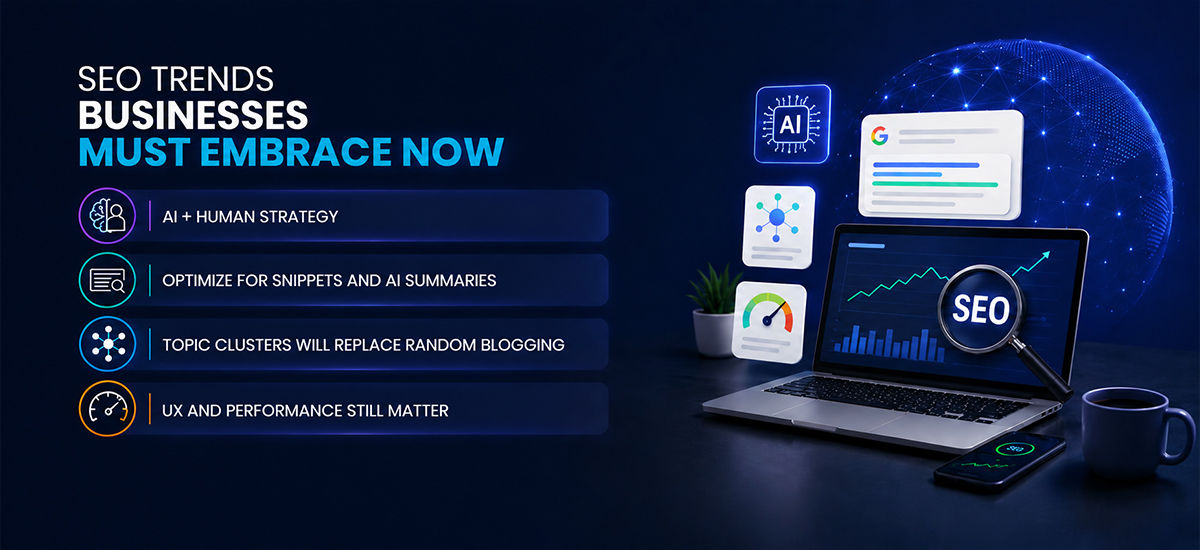
SEO Trends Businesses Must Embrace Now
Hybrid SEO: AI + Human Strategy
AI is excellent for:
Research acceleration
Topic clustering
Draft creation
Content outlining
Optimization suggestions
But AI alone doesn’t create real authority. Businesses that combine AI with a strong editorial strategy and positioning will thrive in the future SEO industry.
Optimize for Snippets and AI Summaries
To show up in AI-driven search answers, your content should:
Use headings based on questions.
Give direct responses in one or two sentences.
Provide a more thorough explanation after that.
Utilize definitions, lists, and procedures
This is foundational for the future of SEO with AI, because content must be easy for machines to detect and extract.
Topic Clusters Will Replace Random Blogging
Instead of publishing disconnected posts, businesses should build:
One main guide, or pillar page
Several cluster pages that support subtopics
Strategic internal linking
This helps Google understand topical authority, a key requirement for the future of the SEO industry.
UX and Performance Still Matter
User experience directly affects engagement metrics and trust. Pages that load fast, read clearly on mobile, and provide easy navigation will outperform clunky sites.
In AI and SEO trends in 2026, attention is scarce. If your content is slow or messy, users bounce—and that hurts performance signals.
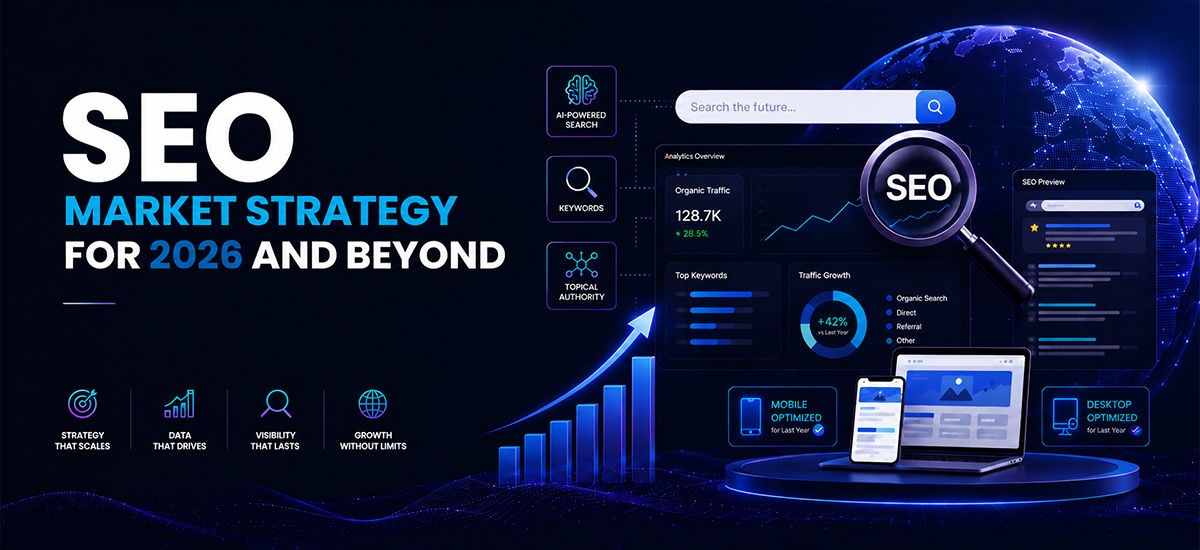
The Business Playbook: SEO Market Strategy for 2026 and Beyond
If your USP is “market strategy,” here’s how to translate SEO trends into real business advantage.
Start with Industry Trend Analysis (Your Core USP)
Before you write a word, you should stay abreast of:
What’s changing in your market
What competitors are investing in
What customers are asking this quarter
Which topics are rising vs fading
Then you build SEO around future demand, not past traffic.
This is how you turn SEO into a market advantage in the future of SEO.
Build a Semantic Content Hub
Create a hub where your brand becomes the “go-to source” for an entire topic. This means:
Broad guide content (pillar)
Supporting pages for each question, pain point, or use case
Strong internal linking structure
Regular updates
This is the strategy that scales in the future of the SEO industry.
Create an AI-Aware Content Workflow
Your workflow should reflect an AI and SEO marketing strategy, meaning:
Research and drafting are supported by AI
People hone their voices, perspectives, examples, and trust.
Content is edited, cited, and verified.
Pages are set up for AI summaries and snippets.
That’s the cleanest model for the future of SEO with AI.
Build Trust Assets (EEAT Boosters)
If you want to rank consistently:
Publish author bios with credentials
Add “last updated” dates
Reference original research and trusted industry sources
Include real examples, case studies, and data points
Create transparent About/Contact pages
Remember, trust will multiply ranking in the future of SEO.
Tools and Capabilities Businesses Should Adopt
To compete in AI and SEO trends in 2026, businesses should invest in:
AI research and clustering tools
Semantic analysis platforms
Schema and structured data tools
Core Web Vitals performance monitoring
SERP/snippet tracking and content refresh systems
The winners will operate like publishers, with strategy and systems.
A Quick Forecast: What Will Win in 2026 and Beyond
Here’s the big picture of the future of the SEO industry:
Semantic relevance beats keyword repetition
Topic authority beats isolated content
Trust beats volume
AI-assisted content beats slow manual workflows
Structured clarity wins snippets and summaries
Strategy-driven SEO beats “random blogging.”
This is why strategically combined AI and SEO marketing will lead the digital space in 2026 and onwards.
Final Takeaway: The Future of SEO Is a Strategy Game
The future of SEO isn’t about hacks. It’s about building a market-aligned content system that search engines trust, users love, and AI can summarize confidently.
If your business uses industry trend analysis to guide topic selection, builds semantic content hubs, and executes a clear AI and SEO marketing strategy, you won’t just “rank sometimes.” You’ll build compounding visibility that grows month after month, even as search changes. If you are looking AI-powered digital marketing services contact us.