
Headless CMS in 2026: When It Beats Traditional Website Builds
Businesses today seek a robust content management system for their website with diverse functionality. One of the high expectations brands today have is showcasing their content through multiple frontends to meet diverse goals. And that’s where headless CMS jumps in.
Headless CMS in 2026 has become a limelight for most of the digital businesses. From social media platforms to service apps and from business directories to e-commerce sites, headless CMS is a top choice. And rightly so.
Headless CMS beats traditional CMS in terms of efficiency, content repurpose, audience engagement, and more. Today, we’re going to highlight what a headless CMS is and how it defeats traditional website builds.
What Is a Headless CMS, Really?
Essentially, a headless CMS is like a restaurant with an extensive delivery system. It means you can cook in the kitchen (which is your backend), and instead of delivering the food to one address at a time only, you can deliver it to several places (multiple frontends).
The ability to deliver to one place is traditional CMS, whereas multiple delivery options denote headless CMS.
Technically, a headless CMS can keep your content separate from the frontend. You keep the content in one place while sending it to different places, like—
Websites
Apps
Digital Signage, or
Voice searches
You can do it through an API. That explains the API-first-CMS term. It means no fixed head or frontend, and your content is free to reach anywhere.
Headless vs. Traditional CMS: How One Beats the Other
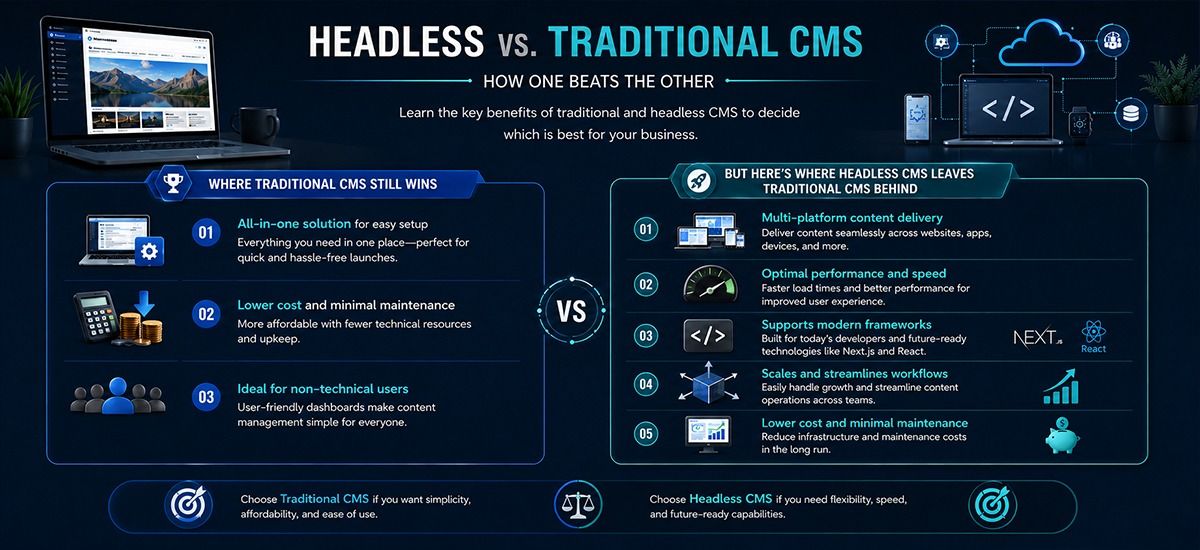
Traditional and headless CMSes have their own benefits and limitations. However, learning about both can guide you in deciding which one to go with for your business.
Where Traditional CMS Still Wins
With traditional CMS platforms—
You can bundle everything together: the editor, templates, hosting integrations, plugins, etc.
You can use them for small business sites, blogs, simple brochures, etc.
They offer fast setup, lower costs, and minimal to no requirement for a developer to update your homepage copy.
A pro tip: If you’re operating with a non-technical team, a traditional CMS platform will be the perfect fit for your business.
But Here’s Where Headless CMS Leaves Traditional CMS Behind
Traditional CMS falls short when—
Your content must appear on multiple platforms: a website and a mobile app simultaneously
You’re badly after page speed and Core Web Vitals
Your web development team wants to adopt modern frameworks like Next.js or React
You need a smooth control over your front-end design and performance
You're scaling fast and need a clutter-free content workflow
In contrast, a headless CMS website comes with a flexible yet effective design that delivers robust performance, better ranking, and limitless growth.
5 Key Benefits of a Headless CMS
The top five benefits that a headless CMS can deliver include:
1. Speed That Actually Affects Rankings
When your front end is decoupled, meaning you can demonstrate your content on multiple devices or screen types instead of just one, developers can build with performance-focused frameworks.
Thus,
The pages load faster.
Google notices.
Your bounce rate drops, and
Your organic visibility climbs (This is one of the most underrated SEO advantages in 2026)
2. True Omnichannel Content Delivery
Write, edit, and finalize your content once. Publish it everywhere.
Website, a mobile app, a kiosk display, or an AI-powered chat interface—you name it. A headless CMS setup can handle it from a single source of information.
No duplication. No inconsistency.
3. Developers Can Build with Freedom
Your frontend developer team is free to work with a vast potential instead of being locked into a theme ecosystem or a page builder's limitations.
They work with the tools they're best at
Build what they actually want to build, and
Ship faster.
This translates directly to lower costs at the development stage, promising better products.
4. Your Sites Enjoy Security Advantages
Without a database-connected frontend exposed to the public, the attack surface shrinks significantly. There's no login page to brute-force, no plugin vulnerabilities to patch every week.
5. Future-Proofing Without Full Rebuilds
Swap your frontend when a better framework comes along. Keep your content untouched.
This is what composable architecture means in practice—moving with modular, replaceable parts rather than one monolithic system you're stuck with.
Common Use Cases: When Teams Actually Make the Switch
Headless CMS may not be the right choice for every project. But the following scenarios seem to be non-negotiable:
E-commerce brands: When you’re managing product content across a website, mobile app, and third-party marketplaces, they must be synced from one CMS.
Media and publishing companies: When you need editorial workflows, versioning, and multi-channel distribution without sacrificing frontend performance.
SaaS companies: When you’re building marketing sites in Next.js with accessible content for non-technical marketers to let them update a headline only.
Enterprise organizations: When you’re running multiple websites or regional properties from a single content repository.
Startups and agencies: When you must build fast, stay lean on cost, and avoid platform lock-in as you grow.
Popular Headless CMS Platforms Worth Knowing
The CMS ecosystem has matured significantly. The industry is welcoming fantastic, productive headless CMSes in 2026, and here’s a list of a few top ones:
Contentful
An enterprise-standard setup for large teams—powerful, well-documented, and deeply integrated with most modern frontend stacks.
Sanity
A developer’s favorite CMS setup. Flexible, clean interface, and real-time customizable. An ultimate agency-friendly CMS setup.
Strapi
The leading headless CMS open source option. Self-hosted, fully customizable, and free at the core.
Directus
Next open-source contender in the list—strong and clean. Works flexibly with any SQL database, adding a clean API and admin panel on top. Lightweight but robust.
Payload CMS
A newer but fast-growing option built natively in TypeScript. Particularly well-suited as a headless CMS for Next.js projects because of how naturally it integrates with the framework.
Hygraph (formerly GraphCMS)
GraphQL-native, built for teams that need a federated content layer pulling from multiple APIs. Complex use cases, handled cleanly.
The above popular headless CMS platforms come with diverse project goals. What will work best for you depends on your team’s technical skills, funding, and the level of control you require over the overall infrastructure.
Headless CMS and Next.js: A Pairing That Makes Sense
If you're building with Next.js — and most performance-focused web projects in 2026 are — a headless CMS fits like a natural extension of the stack.
Next.js handles static generation, server-side rendering, and incremental static regeneration. A headless CMS feeds it clean, structured content via API. The result: pages that are pre-rendered, lightning-fast, and still editable by non-developers without touching code.
This combination is currently one of the most effective architectures for SEO-driven websites. Your content team updates the CMS. The site rebuilds automatically. Google crawls fresh, fast pages. That's the loop.
3 Things to Consider Before Making the CMS Switch in 2026
Headless CMS isn't without trade-offs in 2026, and being honest about them matters. So, think about the following three things before deciding to switch:
Higher initial development cost. Because the frontend is fully custom with zero installable themes. You require skilled developers, time, and budget.
More moving parts. You're managing a CMS, a hosting platform, a frontend deployment pipeline, and potentially multiple integrations. Each piece needs maintenance.
Less intuitive for non-technical editors. Depending on the platform, content editors may need a learning curve. The best platforms minimize this, but it's worth accounting for.
If the above trade-offs feel feasible for your project or if your developers’ team is confident enough to take on the project, you have the best bet. In fact, the long-term gains will most likely outweigh the upfront investment.
Is a Headless CMS Right for Your Next Project?
A real quick answer:
If your website is a standalone brochure that rarely changes, a traditional CMS is okay to go with.
If you're building a versatile site with a need to perform, scale, integrate with other systems, or serve content across multiple channels, headless is the best option.
Build It Right From the Start
At SkillersZone LLC, we design and develop high-performance websites using modern, future-ready architectures, including headless CMS builds tailored to your goals, content workflow, and growth plans.
Whether you're starting fresh or rethinking an existing site, our team brings the technical depth and strategic thinking your project deserves.
Ready to build something that performs? Get in touch with SkillersZone LLC today, and let's talk about what the right stack looks like for your business.