
Local SEO for Dhaka Businesses: A Step-by-Step 2026 Guide
Imagine.
Someone standing outside Bashundhara City needs a phone repair shop right now. They don't call a friend or scroll through Facebook.
Instead, they type "phone repair near me" into Google and walk into whichever shop shows up first. If that's not your business, you just lost a customer to whoever got their local SEO right.
That's the entire game in 2026. Dhaka shoppers, patients, and clients search by neighborhood. Gulshan, Dhanmondi, Mirpur, Uttara, and Google have to decide, in a split second, which business deserves that customer inside the Local Pack (the box of three map listings above the regular organic results).
Here's exactly how to make sure it's you, using the three factors Google itself says it weighs for every local query: relevance, distance, and prominence.
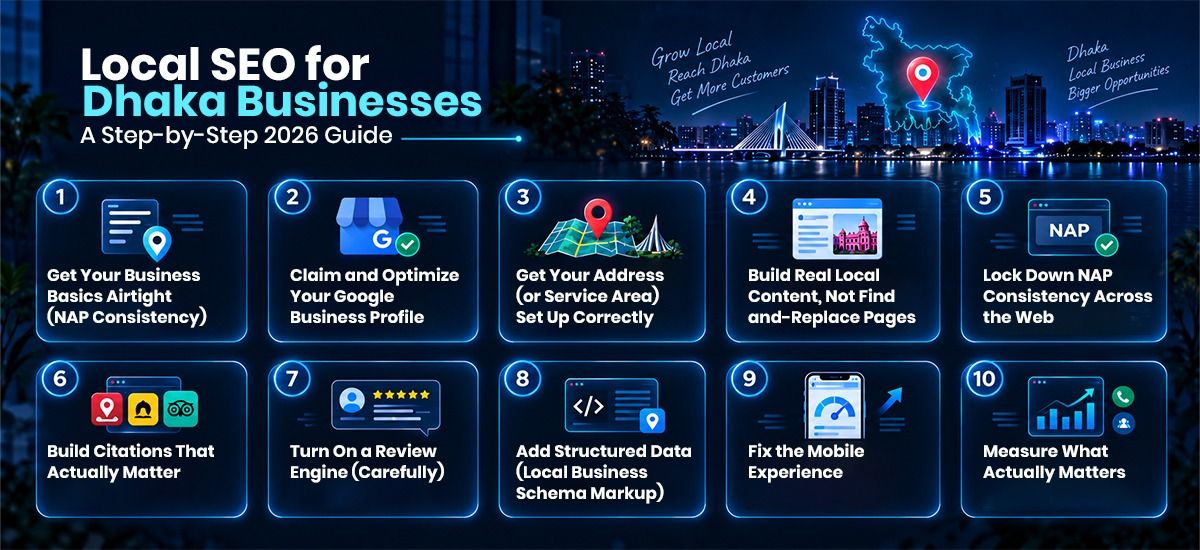
Step 1: Get Your Business Basics Airtight (NAP Consistency)
Before touching Google Business Profile or citations, nail down one document.
Your official business name, full address, phone number, website, hours, and service areas. Write exactly the way you want them to appear everywhere.
This trio, Name, Address, Phone (NAP), is the foundation every other local SEO signal builds on. Every inconsistency you allow now becomes a headache later.
Dhaka's addressing quirks make this trickier than it sounds.
For example, "House 12, Road 5, Gulshan 2" and "12/5 Gulshan-2" look identical to a human but read as two different places to Google.
Pick one format and lock it in.
Step 2: Claim and Optimize Your Google Business Profile
Your Google Business Profile (GBP) is the single most important piece of local SEO real estate you own. It's the entity Google uses to establish prominence, one of its three core local ranking factors alongside relevance and distance.
Claim the listing under an email your business controls, not a freelancer's or ex-employee's
Match your business name exactly to your signage — keyword-stuffed names ("Best Plumber Dhaka Cheap 24/7") are exactly what Google's 2026 spam-detection systems are now trained to catch and suspend
Choose the most specific category available (a "dental clinic" beats "healthcare" every time)
Fill in every field: hours, including Friday/Jummah timing and Eid schedules, services, photos of your actual storefront and team, and a clear, keyword-natural business description
Turn on messaging and pre-populate a Q&A section with the questions customers actually ask
Then don't abandon it.
Profiles that go stale outdated hours, no new photos, unanswered questions – quietly lose ground in local pack rankings to competitors who keep updating theirs.
Step 3: Get Your Address (or Service Area) Set Up Correctly
Not every business should show a street address. If you run a walk-in shop, clinic, or showroom, display it.
Google requires storefront businesses to show a verified physical location.
If you're a service-area business, say, an AC repair company visiting homes across Mirpur, Mohammadpur, and Badda.
Hide the address and define your actual service areas instead.
Don't claim all of Dhaka just to widen your reach; it usually dilutes relevance rather than expanding it, and an inflated service radius is one of the patterns Google's spam systems now flag.
Step 4: Build Real Local Content, Not Find-and-Replace Pages
This is where most Dhaka businesses quietly sabotage themselves.
The classic mistake: build a "Services in Gulshan" page, duplicate it ten times, and swap out the area name for Banani, Dhanmondi, Uttara, and so on.
Google spots this instantly and either ignores those pages or, worse, treats your whole site as thin and templated.
A page worth ranking actually says something specific to that area nearby landmarks, the kind of customers you serve there, area-specific FAQs, and, if it's a real branch, its own photos and reviews.
Weave in the local vocabulary customers actually search with neighborhood names, "near me," landmarks, and transactional phrases like "book" or "consult" without overstuffing.
If you can't write something genuinely different about your Dhanmondi location versus your Uttara one, you probably don't need a separate page for it yet.
Quality beats quantity here, every time.
Step 5: Lock Down NAP Consistency Across the Web
NAP needs to match, word for word, across your website, GBP, Facebook page, and every directory you're listed on.
Consumers notice inconsistency too: plenty walk away from a business the moment they spot conflicting contact details, because it reads as unreliable.
Run a quick audit every few months, searching your own business name, to catch outdated listings from a past office move or an old phone number still floating around.
Step 6: Build Citations That Actually Matter
Citations are mentions of your NAP on other sites, directories, industry platforms, and local associations, and they reinforce the "prominence" signal Google is trying to measure.
In Bangladesh, prioritize the ones that carry real weight: your Facebook Business Page (often trusted by Dhaka customers even more than the Google listing itself), relevant industry directories, and any chamber or association your business genuinely belongs to.
Use a local phone number with the correct area code rather than a toll-free one, which can itself read as a spam signal.
Skip the mass submission services promising hundreds of random directory links; a handful of relevant, accurate listings outperforms a pile of junk ones.
Step 7: Turn On a Review Engine (Carefully)
Reviews are trust signals for customers and a direct contributor to prominence, and Dhaka businesses that ask for them consistently pull ahead of ones that don't.
Build a simple habit: after a good service or sale, send a short WhatsApp or SMS message with your direct Google review link, within a couple of hours while the experience is still fresh.
Respond to every review, thank the good ones by name, and handle the critical ones calmly without getting defensive in public.
One 2026 reality worth taking seriously: never buy reviews or manufacture them in bulk. Google's detection systems are now considerably better at spotting a sudden spike of five-star reviews from accounts with no history, and getting flagged can mean review removal, listing restrictions, or worse.
Step 8: Add Structured Data (Local Business Schema Markup)
This step gets skipped constantly, but it's a quiet advantage.
The LocalBusiness schema on your website tells Google explicitly, not by inference, what you're called, where you are, your hours, and your coordinates.
It won't make a bad website rank, but on a solid one, it sharpens how confidently Google understands and displays your listing, and increasingly, how AI-generated search summaries describe your business.
Step 9: Fix the Mobile Experience
Most local searches in Dhaka happen on a phone, often on the move, often on slower mobile data.
If your site takes more than a few seconds to load or your phone number isn't tap-to-call, you're losing customers who found you but gave up before contacting you.
Compress images, make contact details one tap away, and keep forms short.
Step 10: Measure What Actually Matters
Rankings alone don't pay bills. Calls, direction requests, form submissions, and bookings do.
Use GBP Insights and Google Search Console together to see which searches are bringing people in, and track whether that traffic turns into real enquiries.
A business ranking well for the wrong keyword isn't winning anything.
The 90-Day Reality Check
You don't need to do all ten steps in one week. A realistic rhythm looks like:
Weeks 1–4: Fix NAP, claim and verify GBP, audit existing listings
Weeks 5–8: Build out genuine location content, add schema, start citation building
Weeks 9–12: Launch your review process, chase relevant local links, review your early data and double down on what's working
The Bottom Line
Dhaka's local search competition is only getting sharper in 2026, and the businesses winning it aren't the ones with the biggest budgets; they're the ones with the most consistent, accurate, and genuinely local presence across every touchpoint.
Built the honest way rather than through shortcuts Google is actively cracking down on. Get your Google Business Profile right, keep your information honest and consistent, write content that could only be about your neighborhood, and never stop asking happy customers to say so publicly.
Do that steadily, and you'll be the shop that shows up when someone's standing outside Bashundhara City, phone in hand, ready to walk in.
Frequently Asked Questions
Why did my Google Business Profile suddenly get suspended even though I never touched it?
Google's 2026 spam crackdown is catching a lot of honest businesses alongside the fake listings. File a reinstatement request, prove you're legit, and steer clear of anything that looks like keyword-stuffing or an inflated service area.
A competitor is posting fake reviews or editing my listing, what do I do?
It's a common trick in crowded categories right now. Report it through your GBP dashboard as a policy violation and check your listing often so you can undo any sneaky edits fast.
Should I just hire an agency instead of doing this myself?
Either works, but plenty of Dhaka owners pay for a nice website while their GBP sits unclaimed. Whoever you hire, make sure the profile itself is actually part of the job.
Does GBP still matter with AI search summaries answering everything now?
More than ever, honestly — those AI answers pull straight from your profile and schema data, so a messy listing hurts you in two places at once now instead of one.
I don't have a storefront, can I still show up in local search?
Yep, set yourself up as a service-area business, list the real neighborhoods you cover, and back it up with proper area pages on your site. Don't fake an address to look closer.