
Social Media Marketing in 2026: Why Your Business Can't Afford to Ignore It
Let's Be Honest, Your Business Has a Visibility Problem.
I've been in this industry for 15 years. I watched brands print flyers and call it marketing. I watched the shift from the yellow pages to Google Ads.
And now, I'm watching something even more seismic, and the brands that aren't paying attention are going to get left behind.
Social media marketing isn't a trend anymore. It's the market.
If your business isn't showing up on social platforms in 2026, you're not just missing impressions, you're missing trust, leads, and revenue.
Let me show you exactly why, with the numbers to back it up.
The Scale Is Impossible to Ignore: Where Your Audience Actually Lives
Here's the number that reframes everything: the world counted 5.79 billion social media user identities at the start of April 2026. That's not a niche channel. That's your entire market, scrolling.
Eight new users join every second, and the average user spends 2 hours and 23 minutes daily across 7–8 different networks.
And those users aren't passive. 94.7% of internet users actively use social media. Your customers are on these platforms every single day, researching, comparing, buying, and forming opinions about brands just like yours.
If you're still asking, "Does my business need social media?"
The question you should actually be asking is: how long can I afford to be invisible?
Social Media Has Become the New Search Engine and That Changes Everything
Here's what most business owners don't realize in 2026: social platforms like TikTok, Instagram, and YouTube collectively account for over 60% of product discovery, surpassing Google and signaling a major shift in how people research and decide what to buy.
Read that again. Google has been dethroned, at least for discovery.
TikTok, YouTube, Instagram, and even Reddit are now go-to search engines, especially for Gen Z and Millennials. Consumers actively search social platforms for reviews, tutorials, comparisons, and real-life recommendations.
If your brand isn't optimized for social search, using keywords in captions, leveraging video-first formats, and creating content that answers real questions, you are literally invisible to the next generation of buyers.
This is the 2026 trend that separates growing brands from dying ones.
The Money Is Following the Eyeballs: Social Ad Spend in 2026
Let's talk about where smart money is going.
Social media advertising is projected to reach $338.75 billion in 2026. That's not speculation, that's where brands are investing because it's working.
Ad spending on social media is expected to grow by 10.90% each year from 2026 to 2030. Social media ads account for $3 in every $10 spent on digital advertising. Around 80% of marketing leaders plan to shift budget from other channels to social, and 87% expect their paid social spend to increase.
Your competitors have already made this shift. The question is whether you'll lead or follow.
Short-Form Video: The Format That's Printing Money for Businesses
If there's one content format you need to master for business growth in 2026, it's short-form video. No debate.
The top 3 ROI-driving content formats are all video-based: short-form video (49%), long-form video (29%), and live-streaming video (25%).
Videos strongly influence purchases, with 85% of people saying a video convinced them to buy a product or service. Video quality directly shapes brand trust, with nearly 89% of consumers saying it affects how credible a brand feels.
And the ROI? Businesses that utilize AI-driven, data-backed video marketing strategies report an 82% increase in ROI compared to those relying on traditional creative methods.
This isn't about going viral. It's about showing up consistently in the format your audience prefers, and letting the algorithm do its job.
Brand Trust Is Built on Social, Not on Your Website
Here's what 15 years in the field has taught me: people don't buy from businesses. They buy from brands they trust.
And in 2026, trust is built on social media.
Human-generated content is the #1 priority for users in 2026, and 73% of consumers say they'll switch to a competitor if a brand doesn't respond on social media.
That's not a customer service stat. That's a survival stat.
Consumers expect transparency. Brands that show personality, values, and real people perform better than those relying on overly polished messaging. Through comments, DMs, live streams, and behind-the-scenes content, social media allows brands to build credibility in real time.
Real engagement beats perfect branding every single time. Show up, respond, be human — and your brand loyalty will follow.
Social Commerce Is Here, and It's a $1 Trillion Opportunity
Social media is no longer just a top-of-funnel awareness. It's a full checkout experience.
Social commerce is a $1.09 trillion market, and 78% of purchases happen without leaving the platform. Brands that still redirect users to external product pages see 3.4x higher abandonment rates than those using native checkout.
Approximately 50% of TikTok users have made a purchase immediately after watching an integrated live shopping session.
The path from discovery to purchase has never been shorter. Social media marketing in 2026 isn't just about awareness, it's about closing sales where your audience already is.
Influencer Marketing: The ROI Machine Brands Are Quietly Using
You don't need a celebrity. You need a creator your audience trusts.
Nearly all organizations (94%) say influencer marketing delivers stronger ROI than traditional digital advertising, with a majority reporting at least 2x returns. Around 90% of marketers believe sponsored influencer content outperforms brand content in terms of reach and engagement, while 83% say it converts better.
Nano-influencers represent 75.9% of Instagram's influencer base, and 10.3% average engagement for TikTok nano-creators. Smaller creators with highly engaged niche audiences often outperform mega-influencers on actual conversions.
This is one of the highest-leverage moves a growing business can make, and most brands are still sleeping on it.
AI Is Now Your Social Media Co-Pilot, Use It or Lose Ground
The game changed when AI entered the feed. And it's not slowing down.
AI-powered targeting, predictive analytics, and performance optimisation have made social advertising more precise and cost-effective than ever. Platforms like Meta, TikTok, and LinkedIn enable businesses to test, learn, and scale campaigns quickly.
72% of B2B marketers now use AI-powered social analytics tools, and employee advocacy increases reach by 28%.
AI doesn't replace your strategy. It amplifies it. From content scheduling to audience segmentation to creative testing, the brands using AI in their social workflow are moving faster, spending smarter, and growing harder.
The Competitive Edge Is Real, and It's Up for Grabs
Here's the truth that excites me most after all these years in the industry: the playing field has never been more level.
Trends move fast, and brands that actively participate in conversations and viral moments gain a competitive edge. Being present on social media allows brands to spot shifts in consumer behaviour and adapt quickly, keeping them relevant in an ever-changing market.
73% of businesses are now ditching the "shout at the crowd" approach for authentic, two-way conversations. In 2026, deep community engagement is the only metric that drives real retention.
A small business with a consistent, authentic social media strategy can absolutely outperform a bigger brand that's still broadcasting instead of connecting. The opportunity is right here, but only if you move.
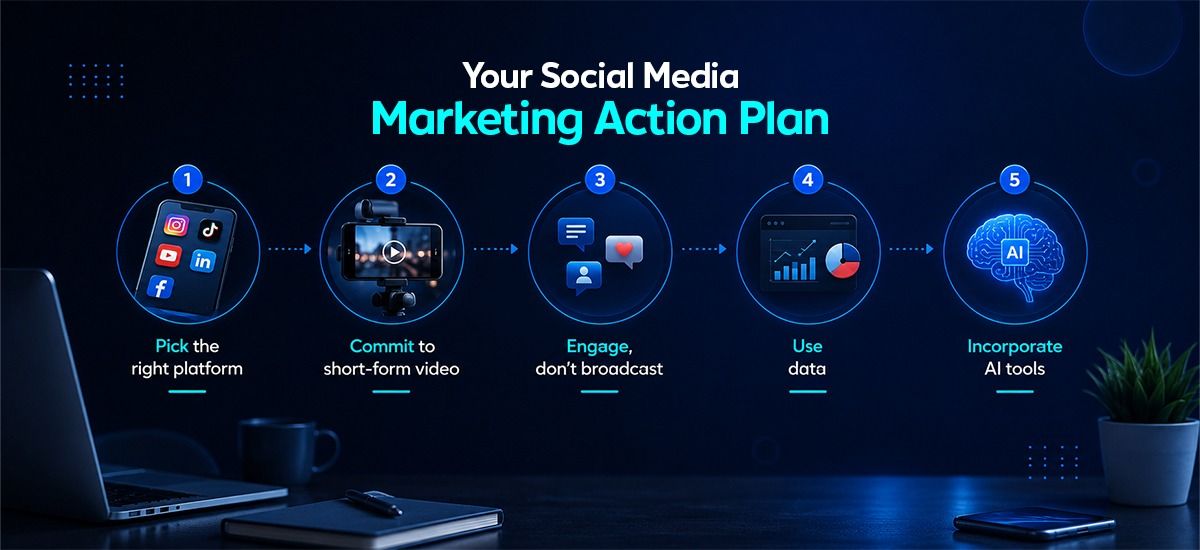
Your Social Media Marketing Action Plan: Where to Start
You don't need to be everywhere. You need to be strategic.
Step 1 — Pick the right platform. Go where your audience already spends time. B2B? LinkedIn. Consumer products? Instagram and TikTok. Local services? Facebook still works.
Step 2 — Commit to short-form video. Even 3 videos per week can dramatically increase your organic reach and brand credibility.
Step 3 — Engage, don't broadcast. Reply to comments. Jump into conversations. Be a person, not a logo.
Step 4 — Use data. Track what works — reach, engagement, conversions — and double down on what performs.
Step 5 — Incorporate AI tools. Use them for content ideation, scheduling, caption generation, and analytics review.
The Brutal Truth: The Window Is Closing
Here's my reality check after 15 years of watching brands succeed and fail: the brands winning in 2026 started their social media strategy seriously, not casually.
The audience is already there. The tools are better than ever. The data makes the ROI undeniable. What's missing is the decision to go all in.
Social media marketing in 2026 is not a "nice to have." It is the single most accessible, scalable, and high-return marketing channel available to businesses of every size. Use it with intention, or hand the market to someone who will.
The choice — and the growth — is yours.
Building a strong online presence is not only about posting consistently. You also need a clear strategy to increase social media engagement organically and create meaningful interactions with your audience.
Still Got Questions? We've Got Answers, Real Ones, Not Textbook Fluff
Is social media marketing actually worth it for small businesses in 2026?
Absolutely. Small businesses with consistent social strategies often outperform larger brands simply by being more authentic and responsive. The tools and platforms are free to start, the only real cost is time and intention.
Which social media platform gives the best ROI for businesses in 2026?
It depends on your audience. YouTube leads for overall video ROI, Instagram dominates for product discovery, LinkedIn is king for B2B, and TikTok delivers explosive reach for consumer brands. Start with one and master it before expanding.
How often should my business post on social media?
Consistency beats volume every time. Three to five times per week on your primary platform is a solid starting point. What matters more is that every post has a clear purpose to educate, entertain, or convert.
Can social media replace my website for business growth?
Not replace, but it can absolutely drive more traffic than your website generates organically. Think of social as the discovery layer and your website as the conversion layer. Both need to work together.
What's the biggest social media marketing mistake businesses make in 2026?
Posting without engaging. Brands that push content but never respond to comments or DMs are wasting their investment. Social media is a two-way conversation, show up for it.
Is paid social media advertising necessary, or can I grow organically?
Both work, but at different speeds. Organic builds long-term trust and community. Paid social accelerates reach and conversion. The smartest brands use both together, starting organic and layering in paid once they know what content resonates.
How do I measure if my social media marketing is working?
Look beyond likes. Track reach, website traffic from social, lead generation, conversion rate, and customer acquisition cost. Engagement is a signal, but revenue is the real report card.
What type of content performs best for business growth on social media in 2026?
Short-form video leads by a wide margin, followed by carousels and user-generated content. Behind-the-scenes content, customer testimonials, and educational how-to posts consistently outperform pure promotional content.
Does social media marketing work for local businesses?
More than ever. Local businesses benefit enormously from geo-targeted ads, Google Business + social integration, and community-focused content. Showing the faces behind your business builds local trust faster than any other channel.
How long does it take to see results from social media marketing?
Paid campaigns can show results within days. Organic strategies typically take 3–6 months of consistent effort before significant traction appears. Brand awareness built through social is a compounding asset, the longer you show up, the greater the return.