
Digital marketing strategy for small business: Make Every Click Pay
If you’re a small business owner in 2026, you already know that online visibility isn’t optional, it’s survival.
The world has changed. Customers don’t just search. They ask AI assistants, scroll reels, watch videos, and expect instant answers. If your digital marketing strategy for a small business hasn’t evolved yet, you’re losing money every day.
But the good news? You can compete with larger brands even with a small budget. By focusing on smart, high-impact channels that convert attention into revenue.
Let’s break down how to build a profitable digital marketing strategy for small business owners like you, without jargon, fluff, or guesswork.
Why Digital Marketing Strategy for Small Businesses Really Matters
A digital marketing strategy for a small business is a connected system. Each channel supports the next.
It aligns traffic, engagement, and conversions. Not random posting or isolated ads.
According to Forbes, small businesses that document their strategy are far more likely to grow sustainably. Planning reduces wasted budget and time.
A strong marketing strategy for a small business answers three questions.
Who is your ideal customer?
Where do they spend their attention?
What action do you want them to take?
Everything else is execution.
High-Intent Google Ads That Solve Real Problems
Why Google Ads Still Matter in 2026
High-intent ads target people already searching for help.
This is a demand, not an interruption.
Google Ads works best when pain points are clear.
Generic ads fail fast.
How to Build High-Intent Campaigns
Start with search intent.
Focus on problems, not products.
Use keywords that show urgency.
"Price," "comparison," "near me," and "solution-based" terms work best.
Create landing pages for each intent.
One page. One problem. One solution.
This approach remains a core part of the best marketing strategy for small businesses in competitive markets.
Organic Social Media Strategy Built on Community
Engagement Beats Followers Every Time
Social media is not a billboard. It is a conversation.
Platforms like Instagram and Facebook reward interaction.
Comments matter more than likes.
A strong digital marketing strategy for a small business focuses on connection.
Not vanity numbers.
How to Build a Real Community
Post content that invites replies. Ask questions. Share behind-the-scenes moments.
Respond to every comment. This signals trust and authenticity.
Community-driven content increases reach without paid ads.
It also improves long-term loyalty.
This is one of the most overlooked marketing tips for small businesses today.
Technical SEO and Website Performance in 2026
SEO Is Now for Humans and AI
Search is no longer just keywords. It is experience.
Google now evaluates site speed, structure, and usability. AI-driven search does the same.
A slow site loses rankings and trust. Visitors leave fast.
Key Technical SEO Priorities
Focus on mobile responsiveness first. Most traffic is mobile. Improve load speed.
Every second matters.
Use schema markup from Schema.org. This helps AI understand your content.
Clear structure strengthens your digital marketing strategy for small businesses across traditional and AI search.
Video Marketing: Short and Long Content That Builds Trust Fast
Why Video Is Non-Negotiable
Video creates a connection faster than text. It shows personality and credibility.
Platforms like YouTube and TikTok dominate attention in 2026. Small brands can compete here.
How Small Businesses Should Use Video
Short videos build awareness. Long videos build trust.
Answer common questions on camera. Explain your process.
Video strengthens every digital marketing strategy for small businesses because it increases engagement and conversion rates.
Conversion Rate Optimization Beats More Traffic
Traffic Without Conversion Is Noise
More visitors do not guarantee sales. Better conversion does.
CRO focuses on actions. Clicks, leads, and purchases. This is why CRO sits at the core of a strong marketing strategy for a small business.
What to Test First
Test headlines. Test call-to-action buttons. Simplify page layouts. Remove distractions.
Study your sales funnel. Find where users drop off. Small improvements compound fast.
This is one of the smartest marketing tips for small businesses with limited budgets.
AI-Assisted Content Creation for Small Teams
AI Levels the Playing Field
AI helps small teams move faster. Not lazier.
Tools like ChatGPT support research and drafting. They do not replace strategy.
How to Use AI the Right Way
Draft blog outlines. Script video ideas. Analyze campaign data. Spot patterns faster.
AI supports a scalable digital marketing strategy for small businesses when guided by human insight.
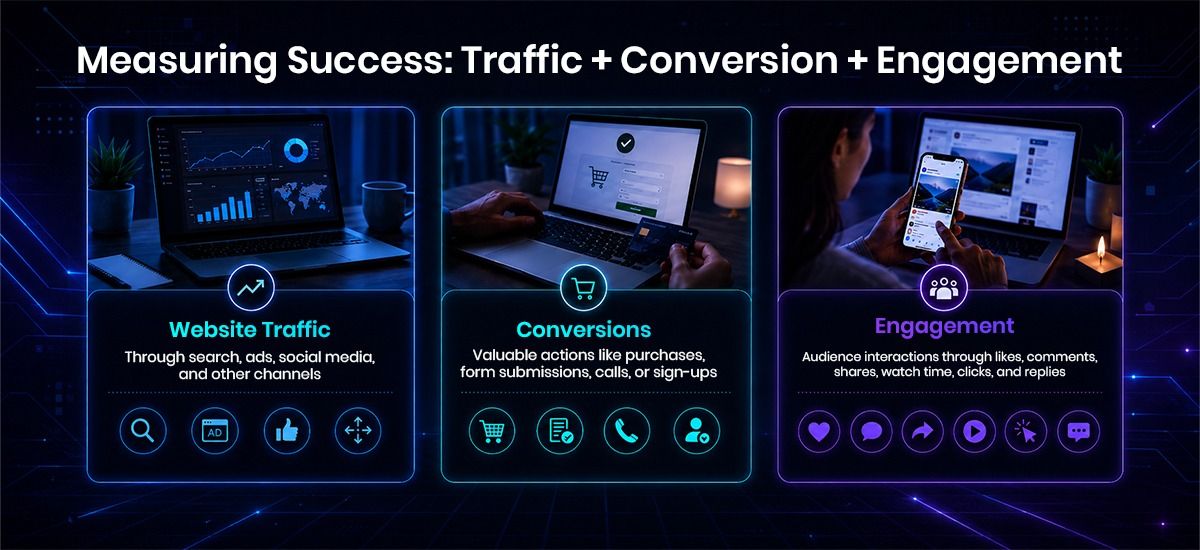
Measuring Success: Traffic + Conversion + Engagement
To measure the real effectiveness of your digital marketing strategy for a small business, don’t just track visits. Look at three key indicators:
Website Traffic: How many people are coming to your site?
Conversions: How many visitors take action?
Engagement: How deeply are people interacting with your social posts, videos, emails, and ads?
A campaign that brings tons of traffic but zero conversions is wasting money. Engagement without traffic means messages aren’t being seen. The sweet spot is balance—traffic that converts and engages.
Final Thoughts: Your Growth Blueprint for 2026
The best marketing strategy for small businesses in 2026 isn’t about flashy tactics. It’s about strategy, measurement, and consistency.
Start by targeting high-intent audiences with smart Google Ads. Build community through organic social interaction. Optimize your site technically. Harness the power of video. Use CRO to make every visit count.
Let AI lighten your workload, but never replace your voice.
The digital world is competitive. With the right strategy, a clear process, and relentless focus on results, small businesses can outmaneuver even big brands.
To understand how search is changing, read our full guide on the future of SEO with AI and how brands can rank on page 1 in 2026.